
Is Synthetic Oil Better for the Environment?
A more honest answer than the marketing claim: yes in one specific way, not in the way most people assume. US & Canada, 2026.
$20/year, up to 25% off every order, no quotas or minimums. See how the membership works →
By Alan Williams, AMSOIL Direct Jobber #1243776 · Tomball, TX · 225-441-6397
20+ years in this industry, and I’d rather give you the honest answer than the marketing version, especially on a claim as easy to oversell as “eco-friendly.”
Last updated 2026. Reviewed against EPA used-oil guidance, OECD biodegradability testing standards, and API engine oil categories.
On This Page
Quick Answer
Yes, in one specific way: synthetic oil lets you change your oil less often, and fewer oil changes over a vehicle’s life means less oil produced, shipped and thrown away, plus fewer used filters.
What isn’t true is that synthetic oil is automatically biodegradable or “green” as a material. Most synthetic base oils, PAO included, don’t qualify as readily biodegradable, and “eco-friendly” on a bottle is a marketing phrase, not a certification. The biggest environmental factor of all is what happens to your used oil.
Where the Benefit Actually Comes From
The Real Benefit: Fewer Oil Changes, Less Waste
Every oil change uses about five quarts of new oil and a new filter, plus the refining, packaging and shipping behind them. It also produces the same amount of used oil and a used filter that have to be collected and handled. Synthetic oil resists breaking down much longer than conventional oil, which is what makes longer drain intervals possible, and fewer changes is where nearly all of its environmental advantage comes from.
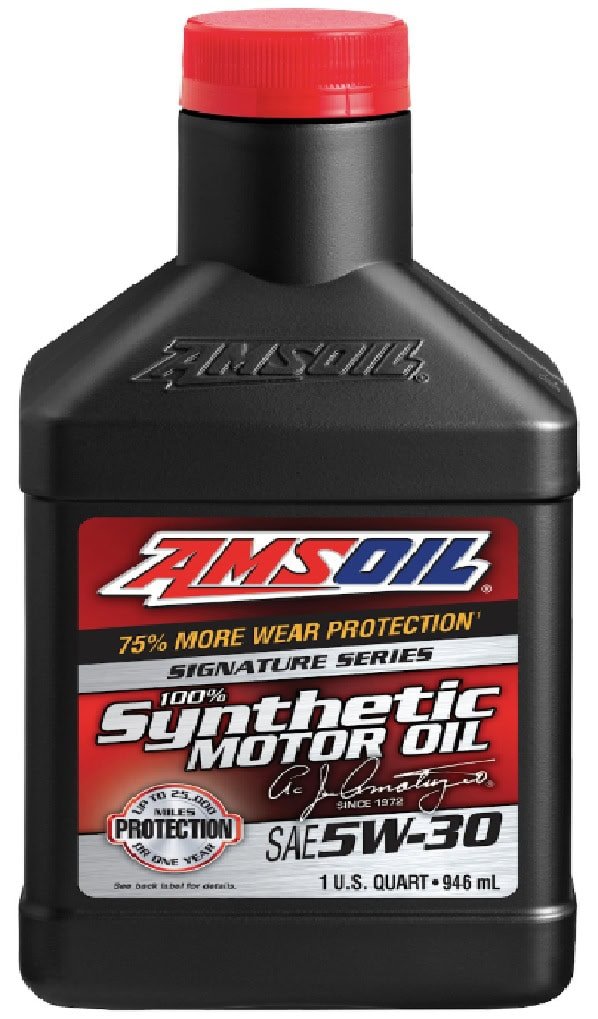
Here’s the simple math over 100,000 miles for a car that takes 5 quarts per change:
| Change interval | Oil changes | New oil used | Used filters |
|---|---|---|---|
| Every 5,000 miles (typical conventional) | 20 | 100 quarts (25 gal) | 20 |
| Every 10,000 miles (typical synthetic) | 10 | 50 quarts (12.5 gal) | 10 |
| Every 25,000 miles (AMSOIL Signature Series, normal service) | 4 | 20 quarts (5 gal) | 4 |
Illustrative only. Your owner’s manual, oil life monitor and driving conditions set your real interval, and severe service such as towing or lots of short trips shortens it. See whether synthetic oil can really go 25,000 miles.
That’s up to 80 fewer quarts of oil and 16 fewer filters over the same distance. Multiplied across millions of vehicles, that is a real reduction in waste.
What the Testing Actually Shows
The Biodegradability Myth
A common assumption is that synthetic oil breaks down more easily in the environment. For most synthetic motor oils, that isn’t true.
The standard lab measure is the OECD 301 family of tests. To be called “readily biodegradable,” a substance has to break down by at least 60% within 28 days. Published OECD 301B results for common polyalphaolefin (PAO) synthetic base oils are typically well below that, often in the 15% to 30% range, which puts them in the “inherently biodegradable” category at best. Conventional mineral oil doesn’t qualify as readily biodegradable either.
The exceptions are certain ester-based (API Group V) and vegetable-based lubricants that are formulated specifically for biodegradability and used where spills are likely, such as some marine, forestry and hydraulic equipment. Most passenger-car motor oils, synthetic or not, aren’t made that way.
So if anything suggests a synthetic oil is safe to spill because it’s “biodegradable,” be skeptical. Used motor oil of any kind is a pollutant.
The Part Marketing Leaves Out
The Honest Trade-Off: Synthetic Takes More Work to Make
Making synthetic base oil takes more processing than refining conventional base oil. PAO is built up from smaller molecules in a chemical process, and Group III synthetics go through extra hydroprocessing steps. Each quart of synthetic carries more manufacturing behind it than a quart of conventional oil.

The environmental math only works in synthetic oil’s favor if you actually use the longer interval. If you put synthetic in and still change it every 3,000 miles, you’ve paid for the extra processing without getting the waste reduction. The benefit comes from fewer quarts over the life of the vehicle, not from the oil itself.
Get the real environmental benefit, extended drain intervals, with AMSOIL Signature Series at wholesale pricing.
The Biggest Factor of All
Recycling Matters More Than the Base Oil
Whatever oil you use, how you get rid of it matters more than which kind it is. According to the EPA, the used oil from a single oil change can contaminate one million gallons of fresh water.
The good news is that motor oil doesn’t wear out, it just gets dirty. Used oil can be cleaned and re-refined into new lubricating oil, and the EPA notes that one gallon of used motor oil yields the same 2.5 quarts of lubricating oil as 42 gallons of crude oil. Collection centers accept synthetic and conventional used oil alike.
- Take it to a collection point. Most auto parts stores, many service shops, and household hazardous waste sites accept used oil free.
- Keep it clean. Use a sealed container and don’t mix in antifreeze, fuel or solvents, which can make the oil unrecyclable.
- Drain and recycle the filter too. A properly drained filter can be recycled, and many collection points take them.
See where to dispose of motor oil for free in the US and Canada.
Reading the Bottle
What “Eco-Friendly” on a Label Really Means
“Eco-friendly” and “green” aren’t regulated terms on a motor oil label, so they can mean almost anything. A more useful thing to look for is the API “Resource Conserving” designation in the API service symbol. Oils that carry it have passed tests for fuel economy and for protecting emission control system and turbocharger components, which are real, measurable benefits.
Fuel economy gains from engine oil are modest and come mostly from using the lower-viscosity grade your engine is designed for. For the bigger picture, see our fuel efficiency guide.
Is Synthetic Oil Better for the Environment? FAQs
Is synthetic oil more biodegradable than conventional oil?
Generally, no. Most synthetic motor oils, including PAO-based ones, do not qualify as readily biodegradable under OECD 301 testing, and neither does conventional oil. Only specially formulated ester-based or vegetable-based lubricants are designed to be readily biodegradable.
What’s the real environmental benefit of synthetic oil?
Longer drain intervals. Fewer oil changes over a vehicle’s life means less new oil, fewer filters, and less used oil to collect and handle. That benefit only shows up if you actually extend your interval.
Should I trust “eco-friendly” labels on motor oil?
Treat them as marketing. “Eco-friendly” is not a regulated term on motor oil. The API “Resource Conserving” designation is more meaningful, because oils must pass fuel economy and emission system protection tests to carry it.
Does it matter how I dispose of synthetic oil?
Yes, a lot. According to the EPA, the used oil from a single oil change can contaminate one million gallons of fresh water. Take it to a collection point; most auto parts stores accept used oil free.
Can synthetic and conventional used oil be recycled together?
Yes. Collection centers accept both, and both can be re-refined into new lubricating oil. Just keep antifreeze, fuel and solvents out of the container, since contamination can make used oil unrecyclable.
Is synthetic oil worse for the environment because it takes more processing to make?
Each quart does take more processing to make. The overall advantage comes from using far fewer quarts over the life of the vehicle by running the longer drain interval synthetic allows. Changing synthetic as often as conventional erases that advantage.
Fewer Changes, Less Waste, Better Protection
Join as an AMSOIL Preferred Customer and get extended-interval full synthetic at wholesale pricing.
- 25% off every AMSOIL product, permanently
- Ships to the US and Canada
- No minimum orders, no obligation to sell
- $5 birthday coupon plus ongoing rewards
$20/yr, Dealer #1243776, ships US & Canada
Interested in Selling AMSOIL Instead of Just Buying It?
AMSOIL Dealers earn commission on every sale, set their own hours, and build a business around a product line people already need. No quotas, no inventory requirements to start.
Continue the Synthetic Oil Guide
Disclaimer & affiliate disclosure: Biodegradability figures reflect OECD 301B standardized testing and published environmental lubricant research; individual product results vary by specific formulation. AMSOIL and all brand names referenced are registered trademarks of their respective owners. Lube Oil Sales is an Authorized AMSOIL Independent Dealer (Dealer #1243776). This page contains affiliate links. Last updated: 2026.