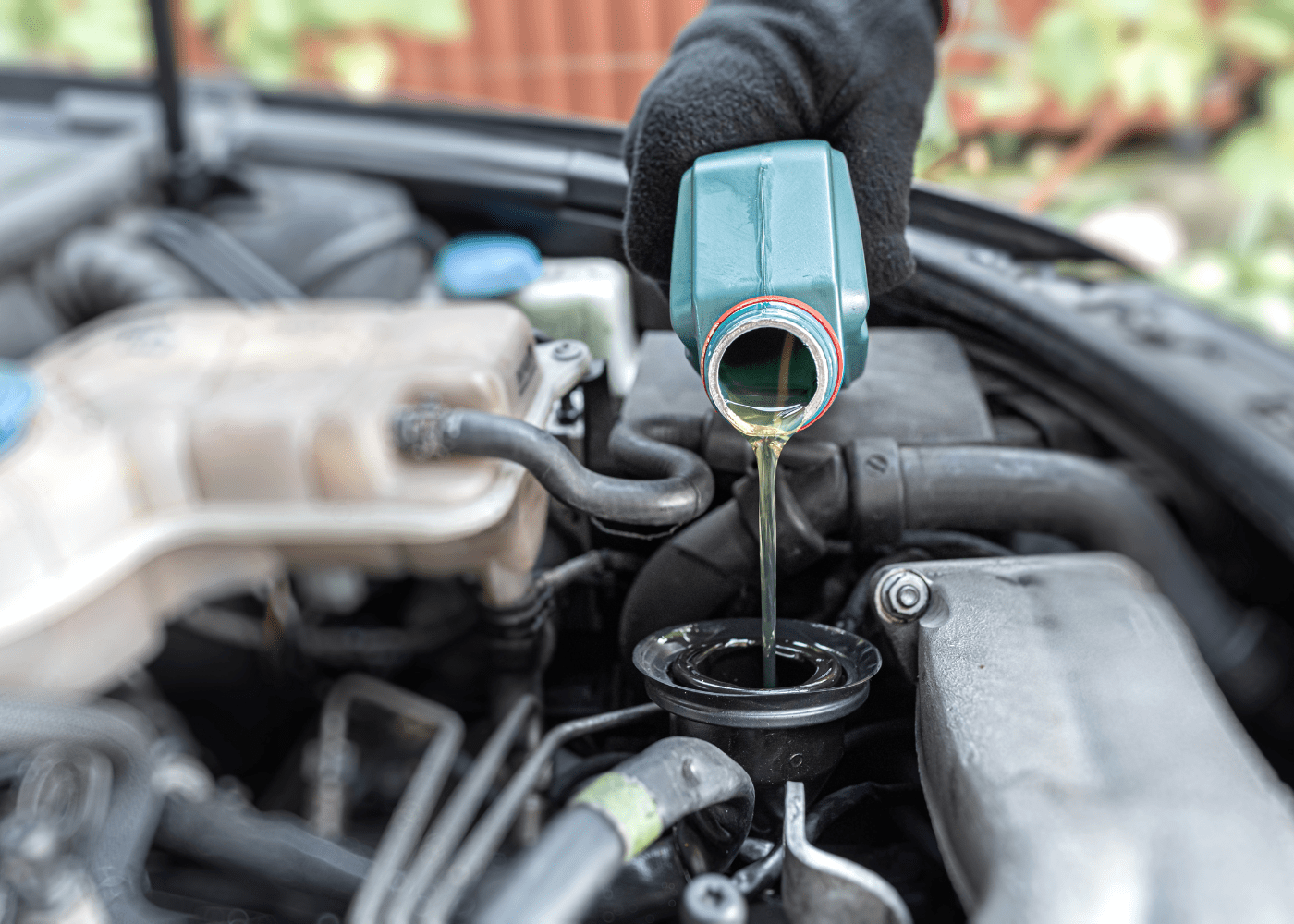
Quick answer: Most 4-cylinder cars take about 4 to 5 quarts of oil, most V6 engines take 5 to 6 quarts, and gas V8s usually take 5 to 8 quarts. Diesel pickups take much more, often 10 to 15 quarts. Those are typical ranges, not your exact number. Your engine’s exact oil capacity is listed in your owner’s manual or in AMSOIL’s free vehicle lookup.
Typical Oil Capacity by Engine Type
Engine
Typical capacity (with filter)
Small 4-cylinder (1.5L to 2.5L)
About 4 to 5 quarts (some turbo 4-cylinders take closer to 6)
Two engines the same size can still take different amounts of oil, because the oil pan, filter and oil cooler differ from one design to the next. Use the table to know what to expect, then confirm the exact number for your engine before you buy.
Your owner’s manual. Look in the “Capacities” or “Specifications” section near the back. It lists the engine oil capacity, usually with a new filter, which is the amount you need for a normal oil change.
AMSOIL’s vehicle lookup. Enter your year, make, model and engine in the AMSOIL Product Guide. It shows the AMSOIL oil recommended for your vehicle and, for most vehicles, the fluid capacities too. It covers cars and light trucks, motorcycles, ATVs, UTVs and snowmobiles.
A dealership service desk or parts store. They can look up the spec from your VIN.
“With Filter” vs. “Without Filter”
Most manuals list the capacity with a new oil filter, because that is how most oil changes are done. The filter itself holds some oil, anywhere from a few ounces in a small car to close to a quart on a big truck. If you change the oil without changing the filter, you will need a little less. Not sure which filter fits? Use our AMSOIL filter cross reference, and see when to change your oil filter.
How to Fill It Right (Without Overfilling)
Park on level ground. A tilted car gives a false dipstick reading.
Pour in about half a quart less than the listed capacity.
Start the engine and let it run for about 30 seconds so the new filter fills. Check for leaks at the filter and drain plug.
Shut it off and wait a few minutes for the oil to drain back into the pan.
Pull the dipstick, wipe it, push it all the way back in, and pull it again to read the level.
Add oil in small amounts until the level reaches the FULL mark, not above it.
On most cars, the space between the ADD (or MIN) mark and the FULL (or MAX) mark on the dipstick is about one quart. If the level reads at ADD, one quart usually brings it to full. Some newer vehicles have no dipstick and show the oil level on the dashboard instead, so follow the procedure in your manual. For more detail, see whether to check your oil hot or cold and how long to let the engine cool before adding oil. For the full job, follow our step-by-step oil change guide.
Why Overfilling Is as Bad as Running Low
Too much oil: If the level gets high enough for the spinning crankshaft to reach it, the oil gets whipped into foam, and foamy oil doesn’t protect as well. Extra oil also puts more pressure on seals and gaskets, which can cause leaks. It can also get pulled into the intake and burned, which fouls spark plugs and can damage the catalytic converter over time. Slightly over the line isn’t an emergency, but if it’s a quart or more over, drain the extra out.
Too little oil: Less oil has to do the same job, so it runs hotter and breaks down faster. Run low long enough and parts start to wear metal against metal. Check the level every few fill-ups, especially on older engines that burn some oil between changes.
Buying the Right Amount of AMSOIL
Once you know your capacity, round up to the next full quart so you have a little left over for topping off between changes. Capacity is only half the answer, though. Your engine also calls for a specific viscosity grade, such as 0W-20 or 5W-30. Use the grade in your owner’s manual or the AMSOIL lookup. Learn more in what 0W-20 synthetic oil is used for, compare the lines in AMSOIL synthetic oil: OE vs. XL vs. Signature Series, or for your mower see the best 4-cycle small engine oil.
Most cars take between 4 and 6 quarts. Small 4-cylinder engines usually take about 4 to 5 quarts, V6 engines about 5 to 6, and gas V8s about 5 to 8. Diesel pickups often take 10 to 15 quarts. The exact amount for your engine is in your owner’s manual or AMSOIL’s free vehicle lookup.
Does a turbocharged engine need more oil?
Not automatically. Some turbo engines hold more oil than a similar non-turbo engine and some don’t. Always go by the capacity listed for your exact engine.
How much oil does an oil filter hold?
It depends on the filter size. A small car filter may hold only a few ounces, while a large truck filter can hold close to a quart. That is why manuals list capacity “with filter” and “without filter.”
What happens if I put in a little too much oil?
Slightly over the FULL mark usually isn’t harmful. If the level is well above the line, around a quart or more, drain the extra out. Too much oil can foam, raise pressure on seals, and get burned in the engine.
Does synthetic oil change how much oil my car needs?
No. Your engine’s oil capacity is the same whether you use synthetic or conventional oil.