
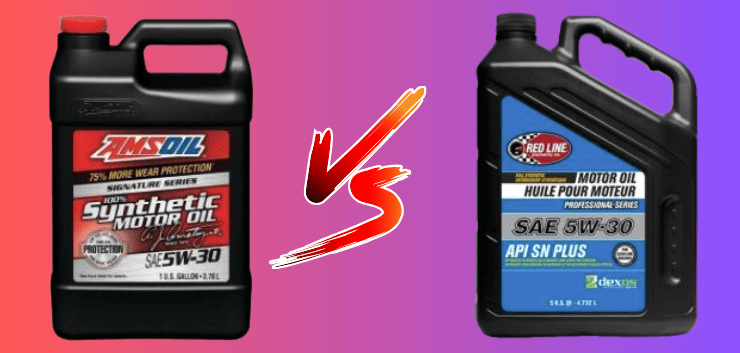
AMSOIL vs Red Line
Red Line is a respected ester-based synthetic with a strong following in racing and enthusiast circles. Here’s what a blind, independently-run ASTM lab study found when it tested Red Line High Performance 5W-30 head to head against AMSOIL Signature Series.
Alan Williams · AMSOIL Direct Jobber #1243776 · Tomball, TX · 225-441-6397
Blind-Tested, Independently Run, One Honest Caveat
What the 2013 ASTM Study Found
AMSOIL commissioned a study testing 10 major synthetic 5W-30 motor oils, including Red Line High Performance, against its own Signature Series. What sets this study apart from most manufacturer comparisons: samples were coded to eliminate bias, tested in random order, and run by an independent third-party lab, with results held to a 95 percent confidence level. The one honest caveat: testing was completed in February 2013, and results reflect the specific batches purchased at that time, not necessarily any reformulations since.
| Test (ASTM Method) | AMSOIL Signature Series 5W-30 | Red Line High Performance 5W-30 |
|---|---|---|
| TEOST deposit formation (D-6335) | 5 mg or less | 29.1 to 31.4 mg (average of three test runs) |
| Cold crank viscosity (D-5293) | 3,727 cP, lowest of all 10 oils tested | Tested within the study’s SN/GF-5 compliant range |
| Four-Ball Wear Test (D-4172 Mod.) | Best wear protection of all 10 oils tested | Tested within the study’s SN/GF-5 compliant range |
| Estimated annual cost, severe service* | $50.75/year | $129.76/year |
*Based on 11,318 average annual miles driven, using AMSOIL’s 15,000-mile severe-service drain interval versus a 4,777-mile average drain interval for oils without a published extended-drain recommendation, per the study’s stated methodology. Your actual costs will vary based on your own driving conditions and drain interval choice.
Running a performance build or daily driver? Tell me your engine and I’ll confirm the right AMSOIL grade, no upsell.
Current Official Positioning
What Red Line Publishes Today
Red Line’s current product literature confirms the same general profile the 2013 study captured, an ester and PAO-based full synthetic built for a wide range of performance applications, without a specific published mileage drain interval.
| Spec | AMSOIL Signature Series | Red Line High Performance |
|---|---|---|
| Base stock | Full synthetic (PAO/ester blend) | Full synthetic, polyol ester/PAO base |
| Published drain interval | Up to 25,000 mi/1 yr (normal service) | No specific mileage figure published; described as supporting “extended” intervals |
| Viscosity grades offered | Application-specific formulas across the full range | 16 viscosities offered |
| Approximate current retail price/qt | Preferred Customer pricing available | Around $18/qt at common retailers |
Get AMSOIL Signature Series at 25% off as a Preferred Customer.
Where Red Line Is a Reasonable Choice
Red Line has earned its reputation in racing and enthusiast circles for real reasons. It’s a reasonable choice for:
- Racers and track-day drivers running short, frequent oil changes where extended-drain economics don’t factor in
- Builds requiring one of Red Line’s 16 specific viscosity grades not commonly stocked elsewhere
- Owners who specifically want an ester-heavy base stock for a particular tuning or sealing characteristic
Common Questions
Is Red Line oil better than AMSOIL?
Not across the board. In the 2013 blind ASTM study AMSOIL commissioned, Red Line High Performance 5W-30 formed 29 to 31 mg of high-temperature deposits versus 5 mg or less for AMSOIL Signature Series. AMSOIL also publishes a drain interval of up to 25,000 miles, while Red Line publishes no mileage figure. Red Line is still a good fit for racers who change oil often or need one of its niche viscosity grades.
Is the 2013 study still relevant if the oils have changed since then?
Fair question. Both companies may have adjusted formulations since 2013, and no equally rigorous independent blind study comparing the current formulations has been published since. What’s still verifiable today: AMSOIL’s published drain interval remains far longer than Red Line’s, and Red Line still doesn’t publish a specific mileage figure, the same gap the 2013 study’s cost comparison was built on.
Does switching to AMSOIL void my warranty?
No. Under the Magnuson-Moss Warranty Act, a manufacturer cannot void your warranty simply for using a different oil brand, provided it meets the required API specification and viscosity grade.
Why does Red Line cost more per oil change if it’s not necessarily better?
Red Line’s pricing reflects its ester-heavy base stock and niche viscosity offerings, real formulation choices, not padding. The cost gap in the study above comes mainly from drain interval, not just per-quart price: more frequent changes at a similar or higher per-quart cost adds up over a year.
Can I mix Red Line and AMSOIL?
Both are compatible with other synthetic and conventional oils, so mixing won’t damage your engine. For best results and to get the full benefit of either product’s specific additive package, drain fully and refill rather than topping off a mixed fill.
Get the Right Oil for Your Build
Call and tell me your engine and how you drive it, and I’ll tell you the exact AMSOIL grade, straight, no upsell.
More Comparisons & Guides
AMSOIL and Red Line are registered trademarks of their respective owners. Lube Oil Sales is an Authorized AMSOIL Independent Dealer (Dealer #1243776). This page contains affiliate links. Blind ASTM lab study data as published by AMSOIL, testing completed February 2013 by an independent third-party laboratory. Current Red Line specifications sourced from Red Line Oil’s official product pages. AMSOIL specifications sourced from AMSOIL’s official product data. Last updated: September 2026.