
How to Change Transmission Fluid Yourself
Transmission fluid change: real torque specs, the fill-plug mistake that strands people mid-job, and when to stop and call a professional instead. US & Canada, 2026.
One service usually covers the membership fee outright, every order after that is pure savings. See how the membership works →
By Alan Williams, AMSOIL Direct Jobber #1243776 · Tomball, TX · 225-441-6397
On This Page
- Quick answer: is this a DIY job for your vehicle?
- When you need a transmission fluid change
- Transmission fluid change cost: DIY vs. shop
- Drain-and-fill vs. flush
- Tools and materials you’ll need
- Step-by-step: drain plug and pan-drop methods
- How to add transmission fluid: where it goes
- The mistake that strands people mid-job
- When to stop and call a professional
- Sealed transmissions (no dipstick)
- Trucks, transaxles and CVTs
- Changing manual transmission fluid
- Choosing the right fluid
- Related reading
- The Preferred Customer program
- Alan’s take
- Frequently asked questions
Quick Answer
Yes, for most vehicles with a drain plug and dipstick, a drain-and-fill is a genuinely reasonable DIY job, typically $50 to $150 in parts if you’re supplying your own fluid, gasket, and filter. It’s more involved if your transmission is a sealed, no-dipstick design that requires a temperature-based level check and a special fill pump, and those are usually better left to a shop.
Worth knowing up front: a basic drain-and-fill only replaces the fluid sitting in the pan, typically 30-50% of total volume, roughly 3 to 6 quarts on many passenger vehicles. It doesn’t touch what’s in the torque converter and cooler lines. If you want more complete replacement, see the full Transmission Flush vs. Drain-and-Fill guide for the decision framework.
Before You Start
When You Need a Transmission Fluid Change
There’s no single interval that fits every vehicle. Many manufacturers call for automatic transmission fluid changes somewhere between 30,000 and 60,000 miles under severe service (towing, hauling, stop-and-go traffic, hot climates) and much longer under normal driving, and some list the fluid as “lifetime” with no change interval at all. Your owner’s manual is the starting point, and its severe-service schedule applies to more drivers than most people assume. Our guide on how often to change transmission fluid breaks the intervals down by transmission type.
Signs a transmission fluid change is due sooner:
- Fluid on the dipstick is dark brown or smells burnt instead of red and fresh
- Shifts have become harsher, slower or less consistent
- The transmission slips or is slow to engage Drive or Reverse
- You’ve been towing, hauling or driving in heavy heat since the last change
Several of those symptoms also show up when the fluid is simply low, so check the level before anything else. See signs of low transmission fluid to tell the two apart.
Is Transmission Fluid Changed During an Oil Change?
No. A standard oil change only replaces the engine oil and the oil filter. Transmission fluid is a different fluid in a separate system, on its own service schedule. Quick-lube shops may check the transmission fluid level or offer a fluid exchange. Before you agree to one, check that the interval and fluid type match what your owner’s manual calls for.
What It Costs
Transmission Fluid Change Cost: DIY vs. Shop
Doing it yourself mostly costs the fluid, plus a pan gasket and a filter if your transmission uses them. At a shop you’re also paying for labor, and dealers usually charge more than independent shops. Typical price ranges:
| Service | Typical cost (U.S.) |
|---|---|
| DIY drain-and-fill | $40 to $120 for fluid, gasket and filter |
| Shop drain-and-fill | About $100 to $350, depending on the vehicle |
| Machine flush (fluid exchange) | $150 to $450 |
| CVT fluid change | $180 to $400 |
| Dealer service | Often $250 or more |
For reference, RepairPal’s national average for a shop transmission fluid change is $294 to $356, before taxes and fees. Prices swing with the vehicle: transmissions that hold a lot of fluid, require a specialty fluid, or need the level set at a specific temperature with a scan tool sit at the top of the range. These are 2026 estimates and vary by region.
Two Ways to Do It
Drain-and-Fill vs. Flush: Which Kind of Change?
A drain-and-fill, the method in this guide, only replaces the fluid that comes out of the pan. The rest stays in the torque converter, cooler and lines, so a single drain-and-fill typically replaces roughly a third to half of the total fluid. Doing two or three drain-and-fills a few hundred miles apart raises the share of fresh fluid gradually.
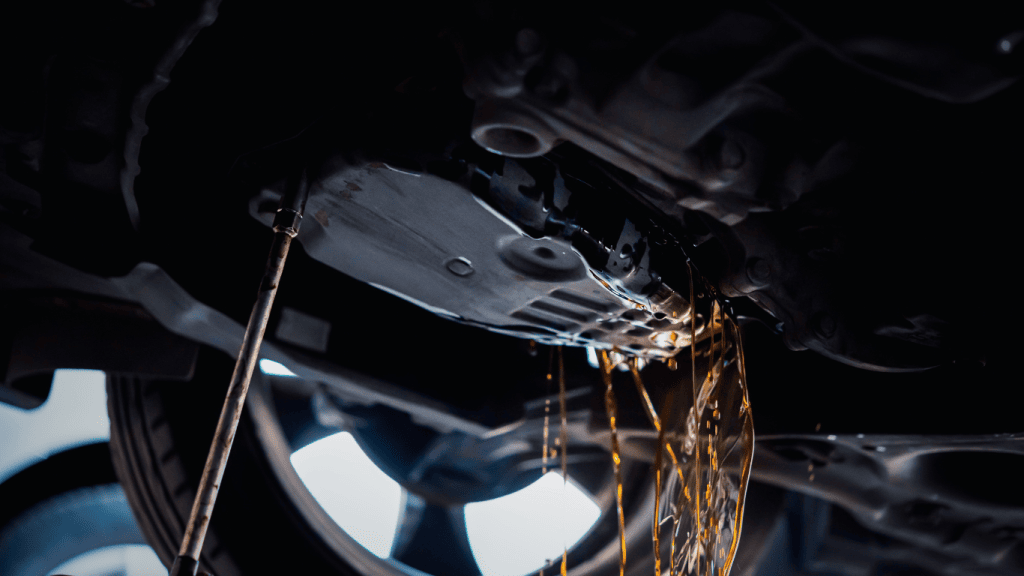
A flush, or fluid exchange, uses a machine connected to the cooler lines to push out nearly all of the old fluid and replace it with new. It’s more thorough, but it costs more, and on a high-mileage transmission that has never been serviced, many mechanics prefer the gentler drain-and-fill. For the full comparison, see transmission flush vs. fluid change.
Before You Start
Tools and Materials You’ll Need
- Jack and jack stands, or ramps
- Large drain pan (clear/marked containers help you measure exactly how much comes out)
- Socket set and a torque wrench, don’t skip the torque wrench, over-tightened pan bolts warp the pan and cause leaks
- New pan gasket (and new filter, if your transmission has a serviceable one)
- Correct-spec ATF, confirmed against your owner’s manual, in enough quantity, most passenger vehicles hold 4 to 12 quarts total
- Long-neck funnel or a fluid-fill pump for transmissions with a side fill port instead of a dipstick
- Brake cleaner or solvent, for cleaning the pan and magnet
The Actual Steps
Step-by-Step Transmission Fluid Change: Drain Plug and Pan-Drop Methods
Some transmissions have a simple drain plug, others require dropping the entire pan. Here’s both:
If your transmission has a drain plug:
- Drive the vehicle 10-15 minutes to warm the fluid, warm fluid drains more completely and carries suspended contaminants out with it.
- Park on a level surface, engage the parking brake, and raise the vehicle safely.
- Position the drain pan, remove the drain plug, and let it drain for about 10 minutes.
- Reinstall the drain plug (with a new crush washer or seal if required) and torque it to the factory spec.
- Skip ahead to the refill step below.
If your transmission has no drain plug (pan-drop method):
- Remove the pan bolts from one side first, leaving two bolts finger-tight in one corner.
- Gently pull the pan to create a gap and let the initial rush of fluid drain into your pan.
- Once it slows to a drip, remove the remaining bolts and lower the pan the rest of the way.
- Clean the pan thoroughly with brake cleaner. Check the magnet, small metal shavings are normal wear; large metal chunks are not, see the stopping-point section below.
- Remove the old filter and O-ring, note its orientation, and install the new one, making sure the O-ring seats properly.
- Scrape off old gasket material and install the new gasket using oil-soluble grease, not adhesive or sealant, unless your manual specifically calls for RTV.
- Hand-thread all pan bolts first, then torque them in a criss-cross or spiral pattern starting near the center, often around 12 lb-ft, but always confirm your specific spec.
Refilling, both methods:
- Lower the vehicle. Locate the fill point, dipstick tube on many vehicles, a side fill port on others.
- Add fluid gradually using a funnel or pump. If you measured what drained out, refilling roughly that amount is a solid starting point, but always verify against the dipstick or your vehicle’s specific level-check procedure.
- Start the engine, let it idle a few minutes, and cycle through all the gears to circulate fluid through the torque converter and cooler lines.
- Recheck the level once warm and adjust as needed. Don’t overfill, overfilled ATF foams and causes shifting problems. See How to Check Transmission Fluid if your vehicle’s level-check procedure isn’t straightforward.
- Check underneath for leaks before considering the job done.
Where It Goes
How to Add Transmission Fluid: Where It Goes
Where the fluid goes depends on how your transmission is built. There are three common setups:
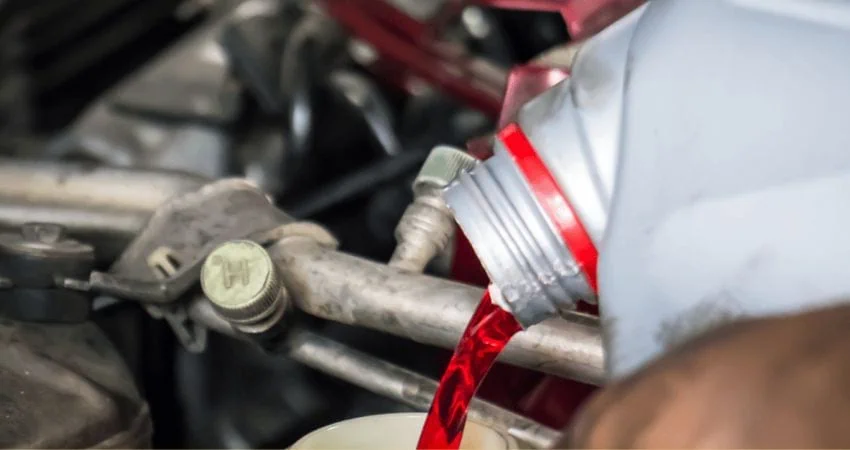
- Dipstick tube (most older automatics and many trucks). Pour through the dipstick tube with a long, narrow funnel. Add about half a quart at a time and recheck between pours. The tube is thin, so going slowly keeps it from backing up and spilling. Most automatics are checked with the engine running in Park on level ground. Some, including many Hondas, are checked with the engine off right after shutdown. Your owner’s manual tells you which.
- Fill plug on the side of the case (manuals and many sealed automatics). Pump fluid in from underneath until it starts to trickle back out of the hole. That trickle tells you the level is right.
- Sealed, no-dipstick automatics. Fluid goes in through a fill port. The level is set with a check plug while the fluid is in a narrow temperature range the manufacturer specifies, often around 100°F. That’s usually read with a scan tool. See sealed transmissions below.
Topping up vs. changing
Transmission fluid doesn’t get used up the way engine oil can. If the level is low, it’s leaking somewhere. Topping up gets you back on the road, but find the leak, usually a pan gasket, cooler line or axle seal. See signs of low transmission fluid. Adding fluid also doesn’t replace the old, worn-out fluid. It only brings the level back up.
The One Everyone Forgets
The Mistake That Strands People Mid-Job
On manual transmissions and some sealed automatic units, there’s a separate fill plug and drain plug, and the fill plug is often stuck tighter or harder to reach. Always confirm you can remove the fill plug before you drain a single drop. If the fill plug won’t budge and you’ve already drained the old fluid, you’re stuck with an empty transmission and no way to refill it until you solve that problem, exactly the kind of DIY mistake that turns a $100 job into a tow-truck call.
Know When to Stop
When to Stop and Call a Professional
- Large metal chunks on the pan magnet (not the fine shavings that are normal wear), that’s a sign of internal damage a fluid change won’t fix, and continuing to drive risks making it worse.
- A sealed, no-dipstick transmission that requires a temperature-probe level check and specialized fill equipment, the margin for error on fill level is much smaller on these designs.
- Existing slipping or hard shifting on a high-mileage, unknown-history vehicle, see the flush vs. drain-and-fill guide before doing anything, since the wrong approach here can expose problems the old fluid was masking.
- You can’t confirm the fill plug will come loose. Don’t drain until you know you can refill.
No Dipstick
Sealed Transmissions (No Dipstick): How the Fill Check Works
More and more newer vehicles have no transmission dipstick at all. You can still change the fluid yourself, but the level check is different:
- Drain and refill through the fill port as usual, adding roughly what came out.
- Start the engine and shift slowly through each gear, pausing briefly in each.
- With the engine running and the fluid in the manufacturer’s temperature range, remove the check plug (sometimes called the overflow plug).
- A thin stream trickling out means the level is right. Once it slows to a drip, reinstall the plug. If nothing comes out, add fluid through the fill port until it does.
Temperature is the part people get wrong. Checked too cold, the transmission ends up overfilled once it warms up. Checked too hot, it ends up low. If you don’t have a scan tool that reads transmission temperature, this is the one step worth paying a shop for.
Trucks, FWD Cars & CVTs
Trucks, Transaxles and CVTs: What’s Different
Trucks
Truck transmissions hold more fluid, and towing or hauling puts them on the “severe service” schedule in most owner’s manuals. That usually means a much shorter change interval. Many trucks also have an external transmission cooler, which holds old fluid that a basic drain-and-fill won’t reach. Two drain-and-fills a few hundred miles apart is a good approach after heavy towing.
Transaxles (most front-wheel-drive cars)
The transmission and differential share one housing. On most automatics they share the same fluid, so one drain-and-fill covers both. Some have a separate differential section with its own drain and fill plugs and its own fluid. Check your manual so you don’t service half the unit and miss the other half.
CVTs
A continuously variable transmission needs CVT fluid made for that specific transmission. Never use regular ATF in one. Most CVTs have no dipstick and use the temperature-based check described above. AMSOIL makes a dedicated synthetic CVT fluid.
Stick Shifts
Changing Manual Transmission Fluid
A manual gearbox is simpler to service than an automatic: there’s no pan to drop, no filter, and no need to run the engine to check the level.
- Loosen the fill plug first. If you drain the fluid and then can’t get the fill plug out, the car can’t be driven until you do.
- Remove the drain plug and let the old fluid drain completely. Wipe any metal paste off the magnetic drain plug.
- Reinstall the drain plug with a new crush washer if it uses one, tightened to the manufacturer’s spec.
- Pump new fluid into the fill hole until it starts to run back out of the bottom edge of the hole, then reinstall the fill plug.
Use exactly what the manufacturer specifies. Depending on the vehicle, that may be a GL-4 gear oil, a dedicated manual transmission fluid, or even ATF, and the wrong one can cause hard shifting or wear the synchronizers.
Getting This Part Right
Choosing the Right Fluid
Never mix different fluid types, ATF and gear oil, or a generic product where your manual specifies an OEM-specific fluid. Mixing different brands of the same type (two Dexron VI fluids, for example) is generally fine, but crossing fluid categories can cause slipping, seal swelling, or worse.
AMSOIL’s Signature Series line covers this in three tiers matched to different OEM specs, from broad multi-vehicle coverage to the tightest current low-viscosity specs. See the full breakdown, including real independent test data, in the Transmission Flush vs. Drain-and-Fill guide.
The Preferred Customer Program
Wholesale Pricing on the Fluid You’ll Need
- 25% off retail pricing on every AMSOIL product, every order, all year
- $20 a year (charged in local currency at checkout for Canadian members), no minimum purchases
- Direct from AMSOIL: all three Signature Series ATF tiers, plus every other product line, at the same discount
- Ships to both the US and Canada
Sign up once, save 25% on every order after.
$20/year, no minimums, ships to the US & Canada.
Alan’s Take
“The number one call I get from a DIYer mid-job isn’t about the drain, it’s someone who’s already dumped the old fluid and just discovered the fill plug won’t budge. Check that first, before you drain anything. Beyond that, this is a genuinely reasonable weekend job on most vehicles with a drain plug. Just use a torque wrench, don’t eyeball the bolts, and don’t skip checking that magnet for anything bigger than fine shavings.”
Frequently Asked Questions
Can I change my own transmission fluid?
For most vehicles with a drain plug and dipstick, yes, it’s a reasonable DIY job costing roughly $50-150 in parts. Sealed, no-dipstick designs requiring a temperature-based level check are more involved and often better left to a shop.
How much fluid comes out during a DIY drain-and-fill?
Typically 3 to 6 quarts on many passenger vehicles, roughly 30-50% of total fluid volume. The rest stays in the torque converter and cooler lines, which a basic drain-and-fill doesn’t reach.
What torque should I use on the transmission pan bolts?
It varies by vehicle, often around 12 lb-ft, tightened in a criss-cross or spiral pattern starting near the center. Always confirm the exact spec in your service manual, over-tightening can warp the pan and cause a leak.
Is metal on the transmission pan magnet normal?
Fine metal shavings or a light coating are normal wear. Large metal chunks or shards are not, that’s a sign of internal damage, and it’s worth having a mechanic inspect the transmission before continuing to drive it.
How much does a transmission fluid change cost?
Doing it yourself typically costs $40 to $120 in fluid and parts. A shop drain-and-fill usually runs about $100 to $350 depending on the vehicle, and a machine flush runs $150 to $450. RepairPal’s national average for a shop transmission fluid change is $294 to $356.
How long does a transmission fluid change take?
A shop usually finishes a drain-and-fill in about an hour. If you’re doing it yourself for the first time, plan on one to two hours, including time to warm the transmission and check the level correctly afterward.
Do I need to replace the transmission filter every time?
If your transmission has a serviceable filter and you’re already dropping the pan, replacing it is a smart move. Some manufacturers recommend it every fluid change; check your specific vehicle’s guidance.
Can you just add transmission fluid instead of changing it?
You can top it up if it’s low, but that doesn’t replace the old fluid, and a low level means there’s a leak to find.
Is transmission fluid changed during an oil change?
No. It’s a separate service with a separate fluid and its own interval.
Should I change the fluid on a high-mileage transmission?
If it shifts normally, yes. A gentle drain-and-fill is usually the safest choice. If it already slips or shifts hard, have it looked at first.
How do you change fluid in a sealed transmission with no dipstick?
Drain and refill through the fill port, then set the level at the check plug with the engine running and the fluid in the manufacturer’s temperature range.
Can I use regular ATF in a CVT?
No. CVTs need the specific CVT fluid listed in your owner’s manual.
Where can I buy AMSOIL ATF at wholesale pricing?
Through the AMSOIL Preferred Customer program: $20 a year for a permanent 25% discount on every order, shipping to both the US and Canada.
Stop Paying Retail for AMSOIL
Membership is $20 a year and knocks 25% off every order, permanently. One service usually covers the fee on its own, so everything after that is straight savings. No minimums, no obligation to sell, cancel anytime.
Dealer #1243776, ships US & Canada
Disclaimer: Procedural guidance compiled from multiple published DIY and manufacturer maintenance sources current as of 2026, and presented as general practice, not a substitute for your specific vehicle’s service manual. Torque specs, fluid capacity, and service procedures vary by make and model, always confirm against your owner’s manual before beginning. AMSOIL is a registered trademark of AMSOIL INC. Lube Oil Sales is an Authorized AMSOIL Independent Dealer (Dealer #1243776). This page contains affiliate links to AMSOIL’s Preferred Customer program. Last updated: October 2026.